
One of the most common questions we get asked daily is: What size wheels and tyres should I run on my Jimny?
Whether you've got a 3-door or 5-door Jimny, choosing the right wheel and tyre setup can make a big difference to the way your car looks, drives and performs - sometimes in ways you may not have realised.
The good news is that there's no real difference between the two Jimny models when it comes to our wheel and tyre fitment recommendations. The main things to consider is your current suspension setup, how you use your Jimny and, of course, the look you're going for!
We've found that some people want to keep things close to factory, others just want a chunkier tyre for weekend adventures, and some simply want their Jimny to look like a monster truck. There's no right or wrong answer.
We've tried plenty of different combinations on our own shop Jimnys, so here's a breakdown of what the numbers mean, what we recommend and what we've learned from running different setups ourselves.
What is the standard Jimny tyre size?
The factory tyre size that all new JB74/JC74 Jimny's (However, Japanese JB64 'Kei' Jimny's are offered with different sizes from the factory) come with is 195/80R15, fitted to the standard alloy 15x5.5-inch +5 offset wheels.

There's absolutely nothing wrong with sticking with the factory setup. It's a great all-round option (especially on sand), but if you're looking for a chunkier look or some extra ground clearance, there are a few popular upgrades worth considering.
If you're planning on keeping your factory wheels and tyres on your Jimny for good - you can often pick up brand new wheels and tyres for extremely cheap, as many Jimny owners swap them out for something better basically as soon as they drive away from the dealership.
Understanding tyre sizes - What do all those numbers mean?

Tyre sizes can look a little confusing if you haven't dealt with them before. From factory, Jimny's use a Dunlop Grandtrek AT20 tyre, with has a size of 195/80R15, as an example.
- 195The width of the tyre in millimetres, measured from sidewall to sidewall.
- 80The aspect ratio. This means the sidewall height is 80% of the tyre's width.
- RStands for Radial, which describes the tyre's construction.
- 15The diameter of the wheel in inches. This tyre is designed to fit a 15-inch wheel.
You'll also see extra numbers and letters after the tyre size, such as 96S. These refer to the tyre's load index and speed rating, which tell you how much weight the tyre can carry and its rated speed capability.
Why are some tyre sizes measured in inches?
You'll notice that most standard tyre sizes use millimetres, like 215/75R15 or 235/75R15. However, once you start looking at larger off-road tyres, you'll often see sizes listed in inches instead.
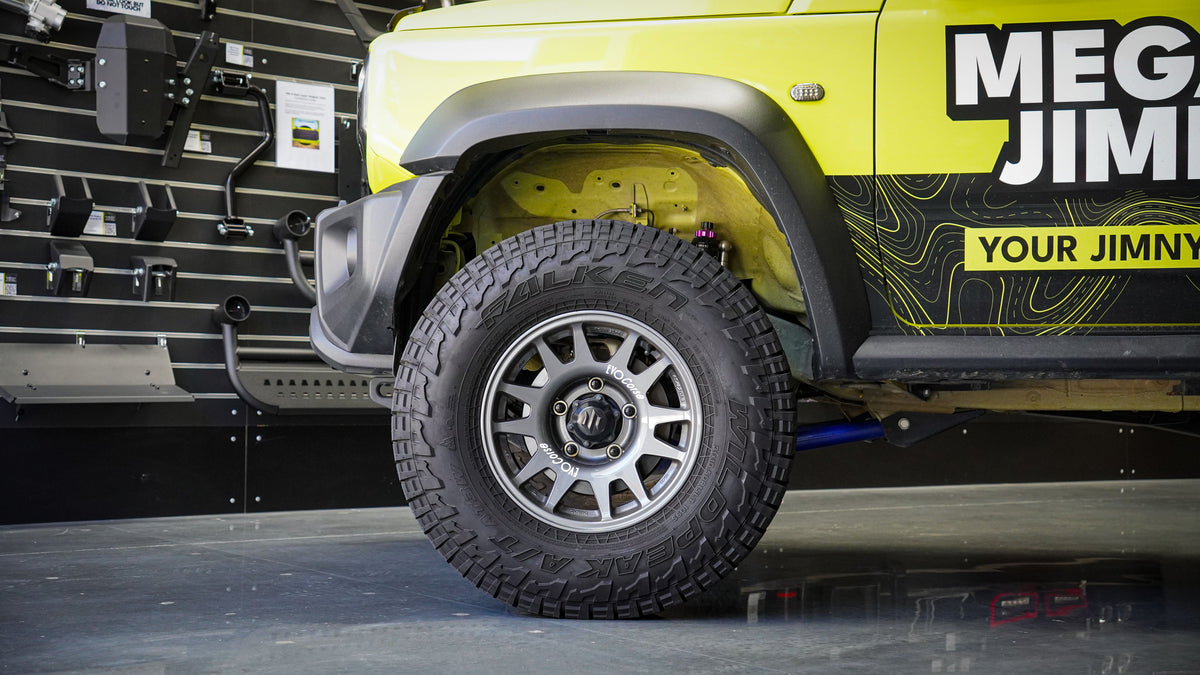
For example, our 3-door shop Jimny runs larger 31x10.5R15 Falken Wildpeak AT3W tyres.

Here's what those numbers mean:
- 31The approximate overall tyre diameter in inches.
- 10.5The approximate tyre width in inches.
- RRadial construction.
- 15The wheel diameter in inches.
So, rather than describing the tyre by its width and sidewall aspect ratio, this sizing system gives you the approximate overall diameter and width of the tyre.
It's particularly common with larger 4WD and off-road tyres.
What do wheel measurements mean?
You'll also come across measurements like 15x5.5, or 15x7 and +3 when looking at aftermarket wheels. Here's a quick breakdown:
15x5.5
15 = Wheel diameter in inches. 5.5 = Wheel width in inches. This is the standard factory Jimny wheel size.
15x7
A 15-inch diameter wheel that is 7 inches wide. It's wider than the factory wheel and gives you more options when choosing a wider tyre.
Wheel offset (+3, +0, or ET3, ET0)
Offset refers to where the wheel's mounting face sits in relation to the centreline of the wheel.
A higher positive offset generally positions the wheel further in towards the vehicle, while a lower offset pushes it further out. On our 3 door Jimny, we run a 15x7 rim with an offset of +0 rim, and on our shop 5 door Jimny, we run a 15x7 rim, with an offset of +3. Both are great size wheels when paired with the right size tyre.
Using these wheel specs make the Jimny's stance be pretty much perfect, with the edge of the tyre being basically in-line with the guard flares.
Keep in mind, if you opt for a more negative offset wheel than what's listed above (which would then bring the wheel and tyre more towards the outside of the car), it could then make your wheel & tyre combo protrude past the plastic guards of your Jimny, which in many places is considered non-roadworthy.
Offset affects your Jimny's stance, but it's not just about looks. It also affects clearance around suspension components, guards and steering components, so getting the right combination is important.
Our recommended Jimny tyre sizes
Now for the part most people are here for!
Whether you've got a 3-door or 5-door, our recommendations are the same. The main thing to consider is whether your Jimny is running standard suspension or has a lift kit fitted.

1. On a standard height Jimny
205/75R15
If you're running standard suspension and don't plan on lifting your Jimny, our recommendation is going for a 205/75R15 sized tyre on the OEM alloy wheels, however you can do a 215/75R15 tyre - but you will notice slight scrubbing when your front/rear differentials are articulating offroad.
This is a popular upgrade from the factory 195/80R15 size. It gives your Jimny a slightly wider, chunkier look without going overboard.
Why we recommend it:
- A wider, more aggressive look than the factory tyre.
- A modest increase in overall tyre diameter.
- A great all-round option for daily driving and weekend adventures.
- A good option without needing a suspension lift.
It's worth remembering that tyre tread design, actual tyre dimensions and wheel offset can all affect clearance, so we'd always recommend checking your exact combination before fitting.
2. On a 2-inch lifted Jimny
235/75R15

If you've fitted a 2-inch suspension lift and want a bigger, slightly more aggressive setup, 235/75R15 is the absolute best size for a JB74/JC74 Suzuki Jimny.
This is the exact combination we're running on our 5-door shop Jimny, which is paired with 15x7-inch wheels with +3 offset.

It's a great setup if you're after a more substantial tyre, a wider stance and that tougher off-road look. It's by far the most popular tyre size that Jimny owners go for once they've got a 2" lift fitted.
Why we like this setup:
- A noticeably larger and wider tyre.
- More ground clearance from the increased tyre diameter.
- A fuller stance that suits the Jimny's body shape.
- Great for a more adventure-focused build.
Our shop 5-door Jimny has a Dobinsons IMS 2-inch lift kit fitted, and this combination gives us the clearance we're after without tyre scrubbing.
And yes, this recommendation applies to both the 3-door and 5-door Jimny!
3. Jimny's with a 3" lift or bigger
31x10.5R15
If you've seen our 3-door shop Jimny, you'll know we're not afraid to go a little bigger!

Our 3-door runs 31x10.5R15 Falken Wildpeak AT3W tyres on 15 x 7-inch EVO Course wheels with +0 offset.
But, this actually isn't a setup we'd recommend for everyone.
Our 31-inch setup is paired with a 3-inch suspension lift aswell as a turbo kit, of course. Even with these modifications, there is some tyre scrubbing, and the additional weight of larger tyres can make a noticeable difference to how the Jimny drives.
Larger, heavier tyres put extra strain on the drivetrain and can make the vehicle feel substantially slower, particularly when accelerating and going up inclines. This is something worth considering before jumping into a bigger tyre setup.
We love the look of this combination, but unless you're building a more heavily modified Jimny with the supporting upgrades, we'd generally recommend sticking with the 215/75R15 or 235/75R15 options.
Our advice: Bigger isn't always better! Think about how you use your Jimny and whether the extra size is worth the compromises.
What's the difference between these tyre sizes?

Here's a quick table comparison to give you an idea of how the different sizes stack up in real world numbers.
| Measurement | 215/75R15 | 235/75R15 | 31x10.5R15 |
|---|---|---|---|
| Approx. width | 215mm | 235mm | 267mm |
| Approx. diameter | 704mm | 734mm | 787mm |
| Wheel diameter | 15" | 15" | 15" |
As you can see, moving from a 215 to a 235 gives you a noticeable increase in size, while jumping to a 31-inch tyre is a much bigger step. However, with that much bigger step, comes a much heavier tyre too.
Actual tyre dimensions can vary between manufacturers and tread designs, so always check the specifications of the tyre you're looking at.
What type of tyre should I choose?
Size is only one part of the equation. The type of tyre you choose is just as important, particularly if you plan on taking your Jimny off-road.
Highway Terrain (HT)
Designed primarily for road use. Generally quieter and more comfortable, making them a good choice if your Jimny spends most of its time commuting or driving around town. Surprisingly, HT tyres have been proven to be great on sand too. In our travels, we've found that many Jimny owners over in places like Japan and the UK tend to go for more of this setup.
All Terrain (AT)
These are definitely our recommendation. A great middle ground for people who use their Jimny both on and off the road. AT tyres offer a more aggressive tread pattern and improved traction on dirt, gravel and a range of off-road surfaces. In terms of actual tyre brands/models, we personally have Falken Wildpeak AT3W tyres fitted on all of our Jimny's, and we would recommend them.

Mud Terrain (MT)
If you're regularly heading into muddy tracks and more challenging off-road conditions, mud terrain tyres might be worth considering. They have a much more aggressive tread pattern designed to clear mud and provide traction in demanding conditions.
The trade-off? They can be noisier on the road and may not offer the same everyday comfort as an AT or HT tyre. Plus in some areas, these can be illegal too.
Our advice? Think about where you actually drive your Jimny most of the time. There's no point running an aggressive mud tyre if 95% of your driving is on the highway!
A few other things to consider
Will bigger tyres affect my speedometer?
Yes. Increasing your tyre diameter changes how far your Jimny travels with each wheel rotation. This can affect your speedometer reading, odometer and effective gearing. It's worth checking your speedometer accuracy after changing tyre sizes.
Usually when you go for larger tyres (we've noticed this especially on our 3 door Jimny), the speedometer reads around 5-10% less than the speed you're actually doing. Which if you're not paying attention, can accidentally get you into trouble from speed cameras, etc.
Do I need wider wheels for wider tyres?
Not always. The suitable wheel width depends on the tyre manufacturer's approved rim-width range. Always check the tyre specifications before pairing a tyre with a particular wheel. If you only want to run a 205 or 215 wide tyre, the factory alloy wheels can work just fine. However, for anything larger - you'll need to get wider rims to accommodate.
What about my spare tyre?
Don't forget about the spare! Ideally, your spare should match the rolling diameter of the tyres fitted to your vehicle. You'll also need to make sure it clears the rear door and rear camera setup (where fitted). Something to keep in mind is that when you fit 31' (or larger) tyres, you run into the issue of the spare tyre blocking out the rear number plate, which will also get you into trouble. This is exactly why we developed our MG-X Spare Wheel Adjuster Mount.

Can I legally fit bigger tyres to my Jimny?
This is an important one, particularly here in Australia. There are state and territory requirements around tyre diameter increases, vehicle modifications, tyre coverage and suspension lifts.
Just because a tyre physically fits doesn't automatically mean the combination is road legal. Always check the applicable regulations before making changes. These change from state to state, so check with your local RMS or mechanic.
So, what would we choose?
If you're still unsure, here's the shortlist:
- Keeping your Jimny standard? Stick with 195/80R15 or upgrade to 205 or 215/75R15 for a chunkier look.
- Running a 2-inch lift? Have a look at 235/75R15 paired with 15x7 +3 wheels.
- Building a more heavily modified Jimny? 31x10.5R15 is another option, but we'd recommend supporting modifications such as a 3-inch lift, a turbo setup, or even some transfer case reduction gears - which can really help with gearing at higher speeds.
And remember, these recommendations apply to both the 3-door and 5-door Jimny!
Ultimately, the best setup comes down to how you use your Jimny and the look you're going for. Whether you're building a capable weekend tourer, heading off-road or simply want to give your Jimny a bit more attitude, there's a wheel and tyre combination to suit.
Still not sure which setup is right for your build?
That's what we're here for! Get in touch with our team and we'll help you work out which setup is right for your build.